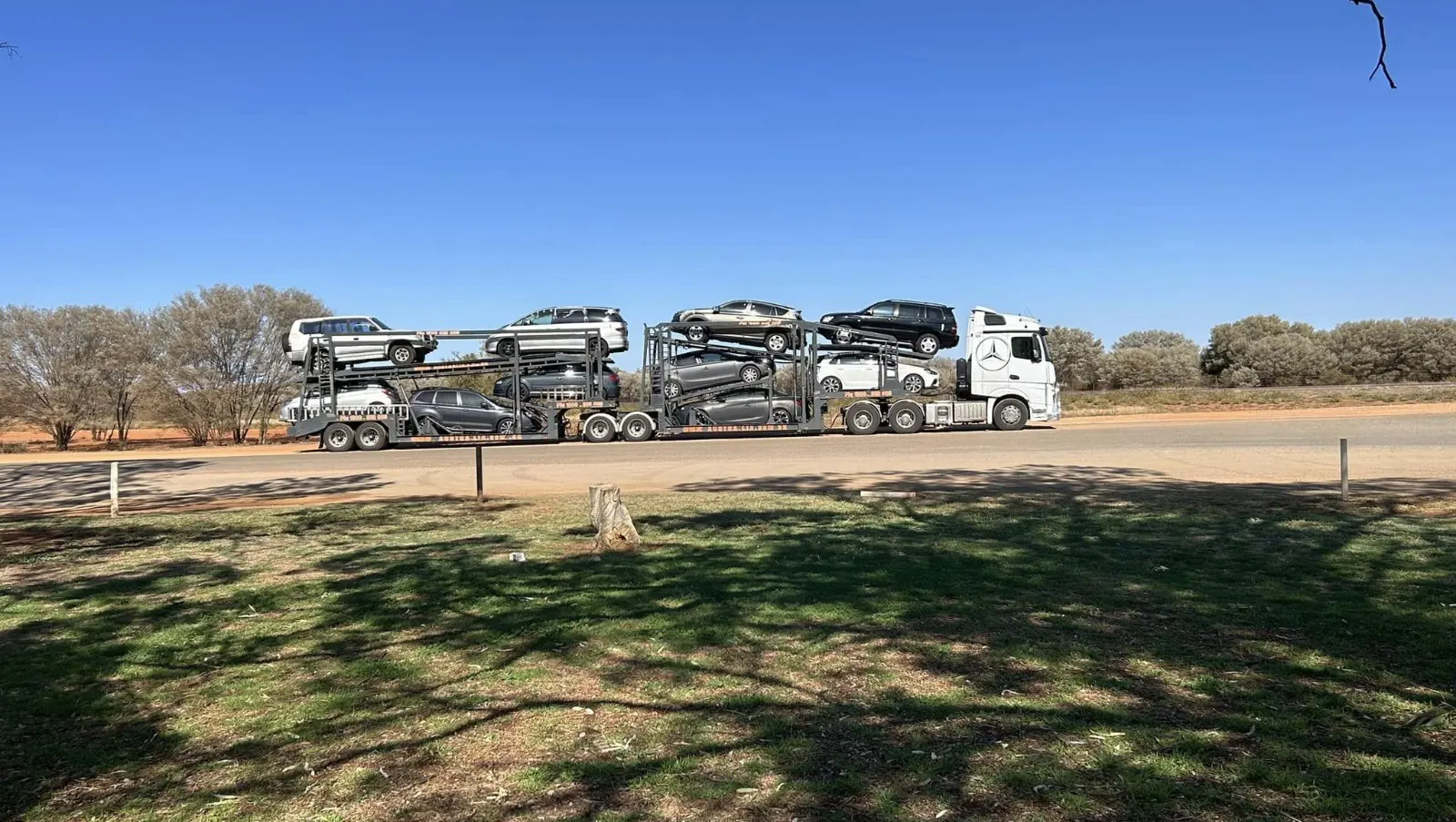
The short answer: Most cars that cross state lines ride on a car carrier truck, a multi-deck rig that moves several vehicles in one run. A tilt tray is a single-car flatbed that tilts down to the road and uses a winch, which makes it the usual pick for non running car transport, low or modified cars, and tight pick-up spots. Which one suits you comes down to three things: can the car be driven, how low does it sit, and where does it need to be collected from.
Moving a car to another state sounds simple until you start researching it. One site says “car carrier”, the next says “tilt tray”, a third mentions “enclosed”, and suddenly you’re reading truck specs at midnight.
We move vehicles around Australia for a living, so here’s the plain-English version: what each truck is, how your car gets on and off, where each one makes sense, and what to tell your transporter so pick-up day goes smoothly.
Picture the double-deck rigs you pass on the Hume Highway: a prime mover hauling a long, ramped trailer with cars lined up on two levels. That’s a car carrier truck. You’ll also hear it called a car transport truck, a car hauler or a car transporter. The names change but the idea doesn’t. It’s a purpose-built rig that carries several vehicles at once, and it’s the backbone of interstate car transport across the country.
Loading is a bit like a puzzle. Cars are driven up hydraulic ramps and strapped down, and the top deck is normally loaded first and emptied last, because a car on the lower deck can stop the top ramp from lowering (Wikipedia). That’s why drivers work to a set loading order instead of grabbing whatever’s closest.
These rigs also play by national rules. The National Heavy Vehicle Regulator (NHVR) sets general access limits for width, length, height and rear overhang, and a vehicle that goes beyond them needs a notice or permit to use the road network. That’s a big reason car carriers look so alike from state to state. For securing cars, the NHVR’s direct restraint guide lists vehicles on wheels, cars included, among the loads held in place with equipment such as chains and straps, and its Load Restraint Guide is the wider best-practice reference.
Where a car carrier truck works best
Where it struggles
A tilt tray, sometimes called a slide-back or rollback, is a flatbed truck whose deck tilts and slides back until its rear edge touches the ground. A winch cable hooks onto the car and pulls it up the shallow slope, the deck levels out, and the car is strapped down. One car per trip is the norm, though some bigger rigs take two.
The gentle angle and the winch are the whole point. Flatbed tow trucks are commonly used for vehicles that can’t move themselves, while car carrier trailers usually rely on the car being driven on (Wikipedia). If a car won’t roll, steer or climb a ramp, tilt tray transport is normally the safer option.
Where a tilt tray works best
Where it’s less ideal
|
Feature |
Car carrier truck |
Tilt tray |
|---|---|---|
|
Cars per trip |
Several |
Usually one |
|
How the car loads |
Driven up ramps |
Winched or driven up a tilted deck |
|
Non running car transport |
Usually not suitable |
Built for it |
|
Low or modified cars |
Depends on ramp angle and clearance |
Gentle slope helps |
|
Best for |
Long interstate runs between major cities |
Short legs, awkward pick-ups, damaged or special vehicles |
|
Pick-up access |
Needs room for a large rig |
Copes better with tight spots |
Non running car transport covers any vehicle that can’t be driven onto a truck. Maybe it’s a flat battery that won’t recover, accident damage, seized brakes, a lost key, a half-finished project or a bargain from an auction yard. Plenty of people assume these cars can’t travel interstate. They can. They just need the right equipment and a little more planning.
Here’s what changes:
When you call, have these answers ready:
Being upfront saves everyone time. Turning up with the wrong truck is a quick way to lose a day.
Whichever truck does the work, the process follows the same rhythm: Request, Collect, Deliver.
Busy corridors such as Sydney to Melbourne and Sydney to Brisbane suit multi-car carriers well. Longer hauls like Melbourne to Perth or Adelaide to Perth cross the Nullarbor, so it pays to book early. Moves out of Tasmania, such as Hobart to Brisbane, include a sea crossing, which adds its own scheduling. You can browse every route on our locations page.
A car carrier truck is a multi-deck rig, usually a prime mover with a ramped semi-trailer, built to carry several vehicles at once. Cars are driven on, strapped down and delivered in a set order. It’s one of the most common ways cars travel between Australian states.
Neither wins every time. A tilt tray is better for cars that can’t be driven, sit very low or need collecting from a tight spot. A car carrier truck is better for drivable cars on busy interstate routes where several vehicles share a trip.
Yes. Non running car transport usually involves a winch-equipped truck such as a tilt tray, plus accurate details about the car’s condition. Tell your transporter whether it rolls, steers and brakes, whether you have the key, and where it’s parked.
It depends on the route, the pick-up schedule and the type of truck. Busy corridors tend to move faster than remote ones, and express options exist for tighter deadlines. Your quote shows an estimated transit time for your specific job.
Generally someone should be, whether that’s you or a person you trust. They hand over the keys and sign off on the car’s condition at both ends. If you can’t be there, tell your transporter in advance.
Cars normally travel empty, with small exceptions like a spare tyre, jack and tools. Limited goods may be accepted under set conditions, so read the terms and conditions before you pack anything. More answers are on our FAQ page.
Tell us where the car is going and whether it runs, and we’ll point you to the right truck. Get a quote, call 02 7251 7123 or email info@easycartransport.com.au. You can also read more about Easy Car Transport or browse our other guides on the blog.