Quick answer: Car transport between Melbourne and Adelaide typically takes a couple of days door-to-door, though exact timing depends on your pickup/drop-off locations, the carrier's route schedule, and the type of service you choose. Cost isn't a flat number — it moves up or down based on vehicle size, distance, carrier type, and how flexible your dates are. The cheapest option is usually a depot-to-depot booking made a little ahead of time rather than an urgent, door-to-door express job. We'll break down all of this below.
If you're relocating, buying a car interstate, or sending a vehicle to family in another state, "car transport Melbourne to Adelaide" is probably the exact phrase you've typed into Google in the last five minutes. Fair enough — it's one of the more popular interstate corridors in the country, and it comes with its own quirks that are worth understanding before you book anything.
This guide walks through the real distance and route, what actually shapes your Melbourne to Adelaide car transport cost, realistic Melbourne to Adelaide car transport time expectations, and a few practical ways to land the cheapest car transport Melbourne to Adelaide has to offer — without cutting corners on safety.
Before getting into logistics, it helps to know the road your vehicle will be carried along. The most direct route connecting the two capitals runs along the Western Highway through Victoria — passing through Ballarat, Ararat, Stawell, and Horsham — before crossing the South Australian border near Bordertown, where the road continues as the Dukes Highway through Keith and Tailem Bend into Adelaide.
This corridor is part of Australia's National Highway network, and it isn't a quiet backroad — the Victorian section alone is officially recognised as the second-busiest national highway in the country by freight volume, carrying over five million tonnes of freight annually, according to Wikipedia's entry on the Western Highway. On the South Australian side, the state government describes this stretch as the primary freight link between Melbourne and Adelaide, also forming part of the broader connection to Perth and Darwin, per the South Australian Department for Infrastructure and Transport. Wikipediadit
In plain terms: this is a well-established, heavily used interstate freight route — which is actually good news for you. High traffic volume means car carriers run this corridor regularly, so there's rarely a shortage of scheduled transport options compared to less common regional routes.
This is one of the most searched questions on this topic, and understandably so — most people need to plan around a settlement date, a new job start, or a flight.
For context, the direct driving distance between the two cities sits at roughly 725–730 kilometres, which translates to about an eight-hour drive non-stop. But your car won't be driven straight through on a dedicated trip — it travels as part of a carrier's broader freight schedule, which changes the timing math a bit.
A few things influence how long your Melbourne to Adelaide car transport time will actually be:
As a general rule of thumb, most standard sedans and SUVs moving between Melbourne and Adelaide are delivered within a few days of pickup. If your timeline is tight, it's worth flagging that upfront when requesting a quote so the transporter can prioritise scheduling accordingly.
We're not going to throw numbers at you here, because honestly, any fixed figure you see online is close to meaningless — pricing is quote-based and shifts with several variables. What's more useful is understanding why one transport job costs more than another, so you know what you're actually paying for.
1. Vehicle size and weight
A compact hatchback takes up less carrier space and adds less weight than a full-size ute or 4WD, which directly affects loading capacity and fuel costs for the transporter.
2. Carrier type: open vs enclosed
Open carriers (the most common type you'll see on the highway) are the standard, cost-effective choice for everyday vehicles. Enclosed carriers protect the car from weather and road debris entirely, which suits classic cars, luxury vehicles, or anything you're particularly precious about — but they cost more to run and book.
3. Pickup and delivery locations
A depot-to-depot booking (where you drop off and collect your car from a fixed location) is typically more economical than a fully door-to-door service, since the carrier isn't diverting off its main route.
4. Distance and route accessibility
Even though Melbourne to Adelaide is a well-serviced corridor, a pickup or drop-off in a regional suburb further from the main highway can add complexity compared to a central metro address.
5. Urgency
Need it there in two days flat rather than working around the standard schedule? Express or priority transport naturally costs more than a flexible, standard timeframe.
6. Vehicle condition
A running vehicle that can be driven on and off the carrier is straightforward. A non-running car requires winching equipment and extra handling time, which adds to the job.
If you want an accurate figure rather than a rough estimate, the fastest way is to get a personalised quote based on your specific vehicle and dates — pricing tools that ask for real details (not just a postcode) tend to give you numbers you can actually trust.
Everyone wants the best deal, but "cheapest" shouldn't mean "riskiest." Here's how to genuinely bring costs down without gambling on your vehicle's safety:
Once you've settled on a provider, the actual process is refreshingly simple. It generally follows three stages:
1. Request
You submit your vehicle details, pickup and drop-off locations, and preferred dates to receive a quote. Being accurate here (correct make, model, and any modifications) means the quote you get is the price you'll actually pay.
2. Collect
Your vehicle is either picked up from your address or dropped off at a depot, depending on the service level you've chosen. It's inspected, documented, and loaded onto the carrier.
3. Deliver
The carrier transports your vehicle along the route to Adelaide (or Melbourne, depending on direction), and you collect it at the agreed depot or have it delivered to your door.
This is essentially the same Request > Collect > Deliver framework you'll find outlined on our home page, and it applies whether you're moving a daily driver, a 4WD, or a vehicle that isn't currently running.
A little preparation goes a long way toward a smooth handover:
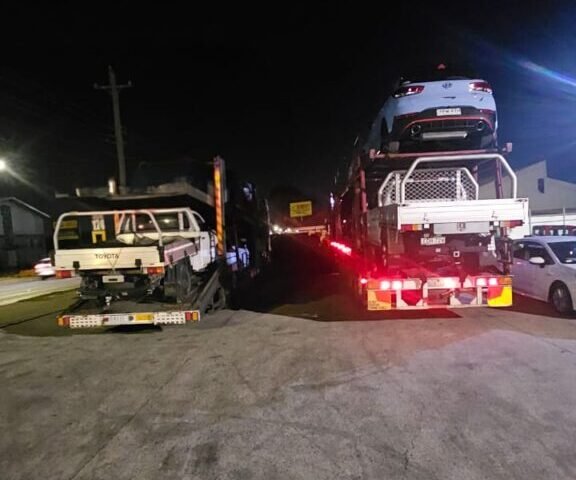
Most Melbourne to Adelaide car transport bookings use open carriers — the same type of multi-level trailer you've probably seen hauling new cars along the highway. They're safe, reliable, and cost-effective for everyday vehicles.
Enclosed transport makes more sense if you're moving a classic car, a high-value luxury vehicle, or something with a show-quality paint job you don't want exposed to road grime and weather for the trip. It costs more, but for the right vehicle, it's worth the extra peace of mind.
How long does car transport from Melbourne to Adelaide usually take?
Most vehicles are delivered within a few days of pickup, depending on carrier scheduling, your chosen service level, and how far your pickup or drop-off point is from the main highway route.
What's the cheapest way to transport a car between Melbourne and Adelaide?
Depot-to-depot transport booked with some lead time, using a standard open carrier, is typically the most budget-friendly combination — provided your dates have some flexibility.
Does the cost depend on the type of vehicle?
Yes. Larger or heavier vehicles, non-running cars, and modified vehicles generally cost more to transport than a standard, driveable sedan or hatchback.
Is my car insured during transport?
Reputable transport providers carry insurance coverage for vehicles in transit, but coverage details vary by company and service type — always confirm what's included before booking.
Can I transport a car that doesn't run?
Yes, most providers can handle non-running vehicles, though it usually requires advance notice since it involves different loading equipment.
Moving a vehicle between two capital cities doesn't need to be stressful once you know what's actually driving the cost and timing. If you're ready to move forward, you can get an instant quote tailored to your vehicle and dates, browse all our interstate routes — including nearby corridors like Adelaide to Sydney — or check our FAQs for more detail on how the process works. You can also learn more about our team and read further guides on our blog.